
Training Considerations for Golf
- connorschoeppsc
- 19 hours ago
- 5 min read

Performance training in golf has changed maybe more than any sport on the planet in the last 2 decades. 20 years ago it was golf fitness where it was filled with excessive movement screens, bad drills that mimicked the swing, and an emphasis on recovery for athletes that weren't even fatigued. Now it has transformed into golf performance. Where golfers are treated like the athletes they are. The focus has shifted to moving well, being strong, explosive, and resilient. The best golfers on the planet can be seen training like an athlete. Lifting heavy weights, jumping, and throwing. This doesn't mean their shouldn't be certain considerations taken when training golfers. Their absolutely should be. But we also want to avoid the dogma that its all about mobility and heavy lifting will get you injured. In this article, I am going to lay out 30,000ft view of how a modern golfer should be training.
Mobility/Movement
Mobility has historically been where the majority of golfers and golf trainers have spent their focus on. This is not necessarily wrong as mobility is important. Whats wrong is our understanding of what mobility is. Mobility isn't about being as "loose" and stretched out as possible. Its about having enough mobility and stability in certain areas order to effectively get in the correct positions to swing the club. To begin addressing this I recommend finding a seasoned professional to assess your mobility and movement abilities. It does not have to be anything grand. It just has to identify any limitations and then provide clear guidance on how to address them. If your interested in a free movement screen, contact us to schedule. Below are some global areas of mobility and movement all golfers should account for.
Thoracic Spine (T-Spine)
The T-Spine is critical to effective rotation. Approximately 65% of your trunk rotation should come from your T-Spine. If you do not have enough range of motion here, your body will often substitute by compensating through your lumbar spine which leads to back pain. When assessing T-Spine range of motion we typically want 40-45 degrees of range of motion. One of my favorite exercises for golfers to improve T-Spine rotation is the side lying 90/90 rotation.

Hips
The hips are key to effective movement and rotation. All movement starts from the pelvis and works out. So, if we want to be efficient distally (Club) we need to efficient proximally (Pelvis). Focus on having sufficient hip internal and external rotation. Usually this means at least 35 degrees of internal and 45 degrees of external. Its this rotation that allows the pelvis to turn and transmit energy into the ball. One favorite exercises to work on both internal and external rotation is the hip 90/90 with reach.
Lumbo-Pelvic Control (LPC)
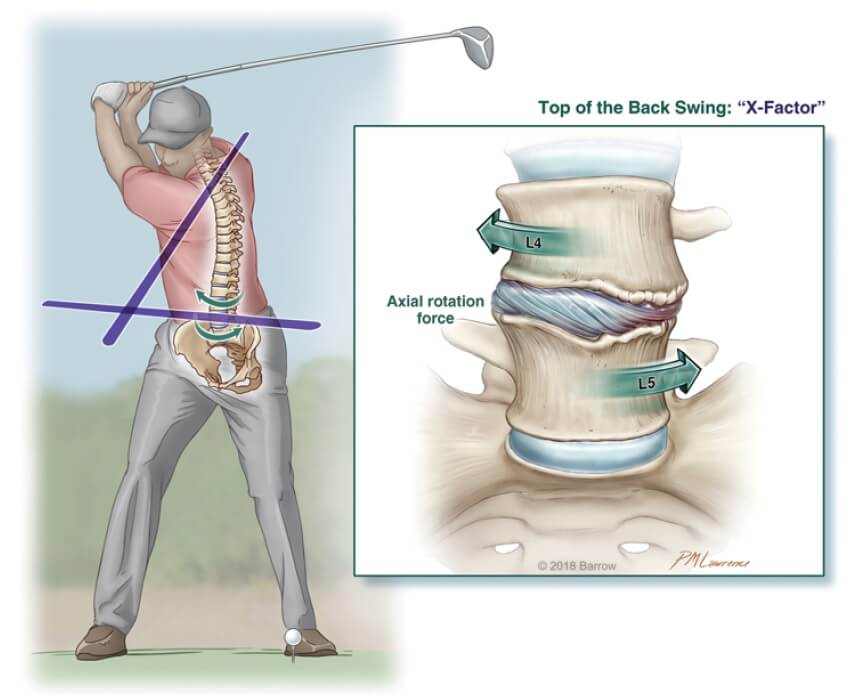
LPC is not necessarily about mobility but more so motor control and where the pelvis sits. Often times golfers can find themselves in a hyper extended position where the pelvis presents with more of an anterior tilt leading to excessive lumbar extension on the follow through. Repeated enough and this can lead to undue stress on the low back and body. Anterior pelvic tilt isn't dangerous. We just do not want to much of it and want to be able to effectively control the pelvis. To learn how to effectively control the pelvis, cat camels are a greater choice. For strengthening anti-extension, dead bugs are a great exercise.
Shoulders
The shoulders can often be forgotten about when addressing mobility. But excess tightness around the shoulders, lats, traps, or chest can lead to poor movement and club path. This leads to undue stress placed on the elbows, shoulders, and neck. Its important that the scapula move efficiently. One of the best mobility and strengthening exercises for this is the prone swimmer.
Foot & Ankle Complex
The foot and the ankle connect the body to the ground. They should provide a stable platform and efficient pattern to effectively transfer ground reaction forces from the ground, through the body, the club, and eventually the ball. Areas to focus on include dorsiflexion, mid foot stability, and pronation/supination. For dorsiflexion the best exercise I have found are ankle rolls.
Power
Power by definition is the product of force x velocity. Developing power in rotational athlete like golfers is arguably the primary key performance indicator (KPI). Power is closely correlated to club head speed which is inherently correlated to drive distance. The farther you drive the ball the greater chance is for success. Greater power also means shorter shots require less energy and effort. There are 3 ways to improve power. Increase force, increase velocity, or improve the skill. Since we will talk about strength training in the next section, well focus on the latter 2 here.
One of the easiest ways to track power is through the counter movement jump (CMJ). At Rebuild, we track this daily to ensure progress is being made and to monitor athlete readiness. Other plyometrics like hurdle hops and box jumps are also great ways to develop power. While important, these movements are all very general as power is plane specific. Meaning while we will still perform vertical movements like the ones mentioned above. We also want to perform exercises in the planes specific to the swing like lateral and rotational movements. This could include things like rotational medicine ball throws, lateral skater hops, or even horizontal jumps in some cases.

Strength
Strength training has shown to be the best performance and injury mitigation tool we have at our disposal. It was a non-factor in golf until recently when elite golfers have started to realize the immense impact strength training can have on performance/health. You do not need to train like a power lifter or body builder. But you do need to move well, get under moderate to heavy load, and do so consistently. This is where most golfers need to start if they want to improve their power. By increasing strength and force you automatically improve your power as long as velocity is maintained.

Simply training 2x per week during the season and 3x per week in the off season is more than enough to continue to develop and build resilience. Focus on compound movements like squats, lunges, hinges, presses, and pulls. These are the foundation of your training. Perform 3-5 sets for 3-10 reps. of each pattern. Then we can build in accessory work with power, core, and accessories specific to that athlete.
Putting It All Together
These are the primary aspects to consider when training as a golfer. Now we need to put it all together for complete all encompassing training program. Here is an example of what a good training program for a golfer may look like.
Specific Warm Up
A1. Underhand Rotational Med Ball Throw 3x3ea
A2. Box Jump 3x3
B1. Dumbbell Reverse Lunge 3x5ea
B2. 90/90 With Reach 3x5ea
C1. Single Arm Dumbbell Bench Press 3x8ea
C2. 1/2 Kneeling Single Arm Pull Down 3x10ea
D1. DB RDL 3x6
D2. 1/2 Kneeling Chop 3x8ea
This is what a simple but extremely effective training session for a golfer should look like. A warm up targeted to address the athletes mobility and movement deficiencies. General and specific power development. Progressively loaded compound exercises to improve strength.
Closing Thoughts
Golfers are athletes first just like football, hockey, basketball, baseball or track. And finally we are in a place where the elite golfers are starting to train like it. But now its time the rest of the golf community catches up. It doesn't matter if you are a pro, youth, or even just recreational golfer. If you are looking to improve your game you have to take your physical development seriously. And its not something you just do in the winter time when the course is closed. Its a lifestyle build around making you the most optimal athlete you can be.
Need help with training for golf? Not sure where to start contact us today to learn how Rebuild can help you!


Comments